TMUA 2023
40 questionsAverage question rating / 5: P1 2.70 · P2 2.75
2023 reference: P1 2.70 · P2 2.75
Most common: Logic & proof (13), Integration (6), Differentiation (4).
TMUA past papers
Sit the 2016–2023 papers free in Forge’s Pearson VUE-style digital format. Get your raw mark, historical TMUA score, a separate current-scale estimate and feedback on what to practise next. New to Forge? Try the free 20-question diagnostic first.
Included with a free account
Turn a released paper into a full practice sitting, with automatic marking and a clear next step when you finish.
Sit in a Pearson VUE-style digital format, with an on-screen timer, flags and a question navigator. Choose timed or untimed practice; sitting both papers gives each its own 75-minute clock.
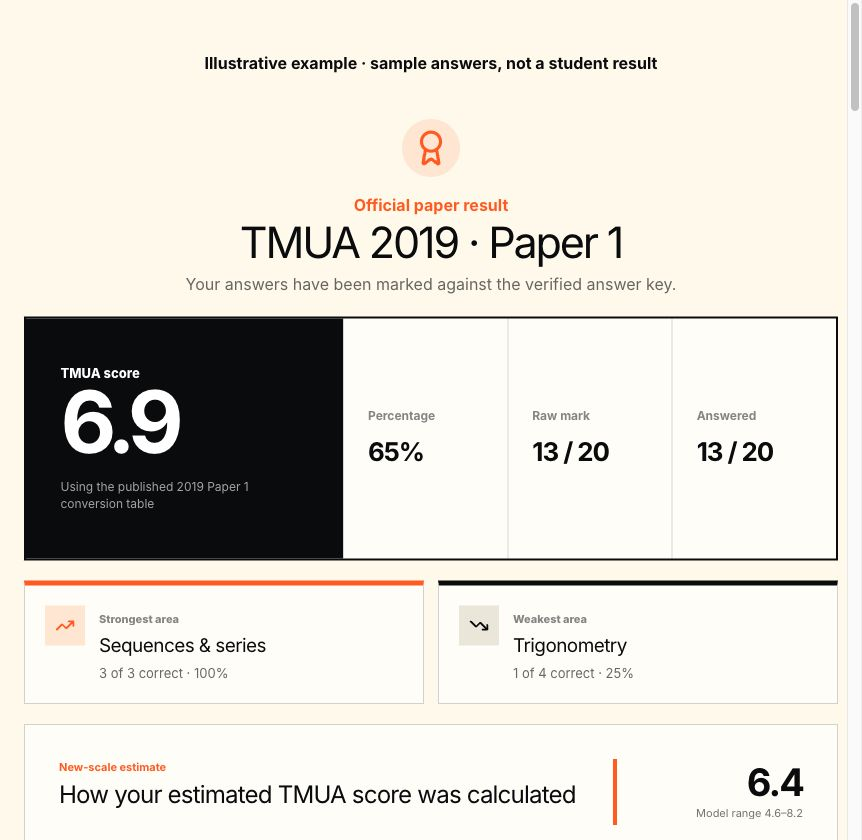
Get your raw mark and the TMUA score from that paper’s historical conversion table. Then see a separate Forge estimate on the current TMUA scale, adjusted for question difficulty and shown with a model uncertainty range.
See which questions you got right, where you lost marks and how long you spent on each. Review your strongest and weakest topics, open worked solutions after submitting, and follow links to the relevant free lessons.
The current-scale estimate is a Forge model, not an official conversion or a prediction of your exam result. For 2016, the historical score is also an estimate using the 2017 table.
Choose a free paper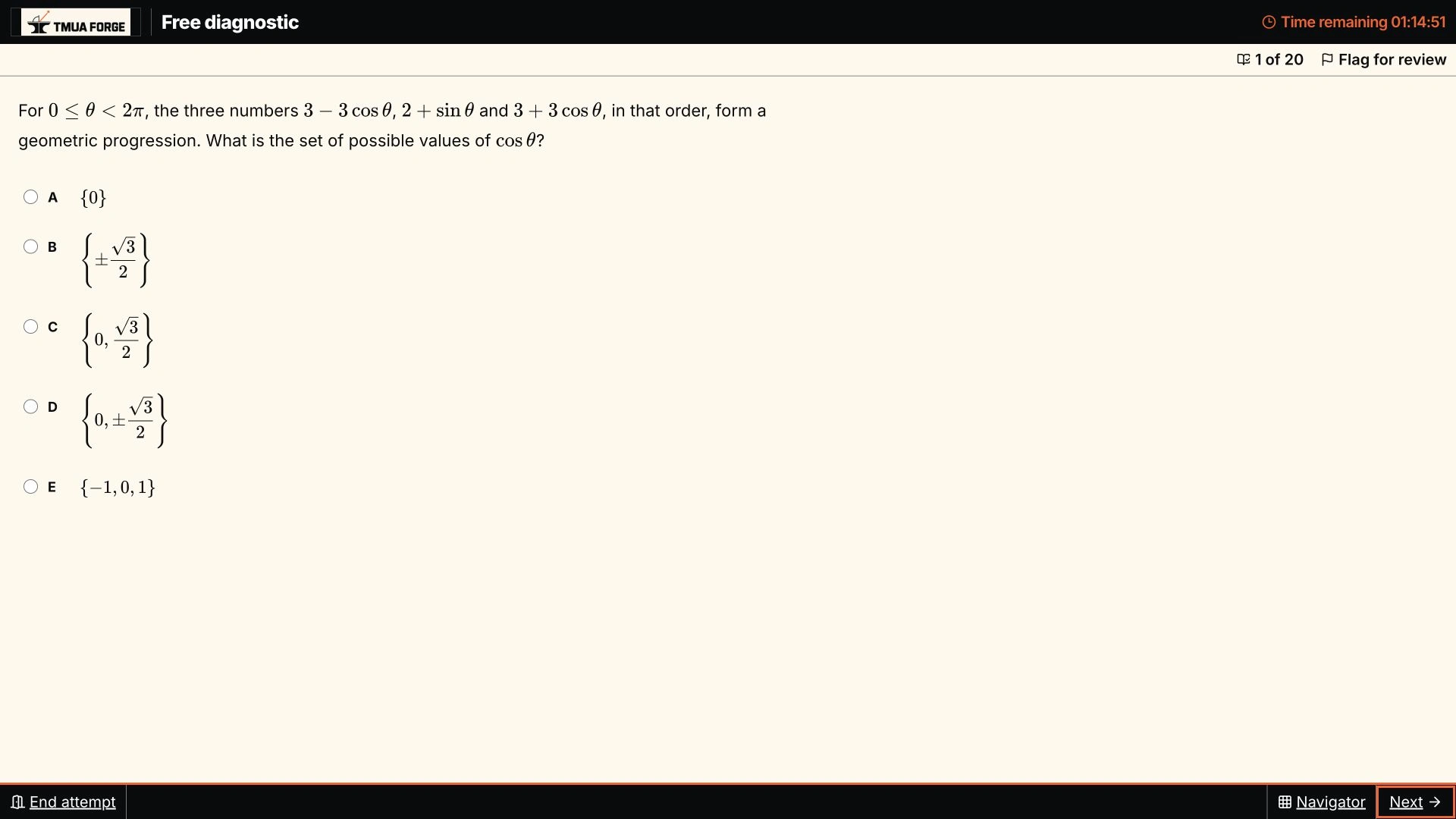
The released archive
UAT-UK says the content specification and question style are unchanged since the TMUA became computer-based, so the released papers are still the best historical reference. There are only sixteen of them, and once you have seen a paper it can never be a fresh test again.
The official PDFs are free. A free Forge account also includes timed or untimed sittings, marking and worked solutions after submitting.
Marked a paper yourself? Convert your raw marks| Year | Official PDFs | Score in Forge | Best used for |
|---|---|---|---|
| 2023 | Papers, worked answers, answer keys | Published score conversion | Final checkpoint |
| 2022 | Papers, worked answers, answer keys | Published score conversion | Final checkpoint |
| 2021 | Papers, worked answers, answer keys | Published score conversion | Mid-preparation |
| 2020 | Papers, worked answers, answer keys | Published score conversion | Mid-preparation |
| 2019 | Papers, worked answers, answer keys | Published score conversion | Early practice |
| 2018 | Papers, worked answers, answer keys | Published score conversion | Early practice |
| 2017 | Papers, worked answers, answer keys | Published score conversion | Early practice |
| 2016 | Papers, worked answers, answer keys | Labelled estimate from the 2017 table | Early practice |
| Specimen | Papers, worked answers, answer keys | Official PDF only | Warm-up |
Each paper has 20 multiple-choice questions in 75 minutes, and calculators are not allowed. Sit Paper 1 and Paper 2 as separate timed blocks without pausing, and note every question you left blank or guessed.
Begin with the older papers and keep 2022 and 2023 for the final weeks, when an honest timed result is most useful. Leave time between papers to fix what each one exposed.
Mark with the official answer key, then retry every wrong or guessed question before reading the worked answer. Turn the topics behind those questions into focused practice before you sit the next paper.
Choose a year below. A free account gives you timed or untimed sittings, automatic marking and that paper’s worked solutions after submitting. 20 paper sittings per rolling 7 days; premium is unlimited. Individual question retries stay premium.
Average question rating / 5: P1 2.70 · P2 2.75
2023 reference: P1 2.70 · P2 2.75
Most common: Logic & proof (13), Integration (6), Differentiation (4).
Average question rating / 5: P1 2.80 · P2 2.50
2023 reference: P1 2.70 · P2 2.75
Most common: Logic & proof (12), Trigonometry (7), Sequences & series (6).
Average question rating / 5: P1 2.65 · P2 2.35
2023 reference: P1 2.70 · P2 2.75
Most common: Logic & proof (11), Coordinate geometry (6), Trigonometry (6).
Average question rating / 5: P1 2.20 · P2 2.25
2023 reference: P1 2.70 · P2 2.75
Most common: Logic & proof (10), Inequalities (7), Integration (4).
Average question rating / 5: P1 2.25 · P2 2.30
2023 reference: P1 2.70 · P2 2.75
Most common: Logic & proof (12), Integration (6), Differentiation (4).
Average question rating / 5: P1 2.15 · P2 2.40
2023 reference: P1 2.70 · P2 2.75
Most common: Logic & proof (12), Trigonometry (6), Differentiation (5).
Average question rating / 5: P1 2.25 · P2 2.35
2023 reference: P1 2.70 · P2 2.75
Most common: Logic & proof (9), Integration (6), Coordinate geometry (4).
Average question rating / 5: P1 2.30 · P2 2.50
2023 reference: P1 2.70 · P2 2.75
Most common: Differentiation (8), Logic & proof (7), Trigonometry (6).
Across all 320 questions, logic & proof is the primary topic for 86 (27%). Each question is counted once, under its main topic.
Ink: Paper 1. Peach: Paper 2. Select a topic for its free lessons.
Logic & proof: 0 questions in Paper 1 and 86 in Paper 2. Use the year maps to see where it appears, then review the methods behind missed questions.
Trigonometry: 30 questions in Paper 1 and 11 in Paper 2. Use the year maps to see where it appears, then review the methods behind missed questions.
Integration: 24 questions in Paper 1 and 11 in Paper 2. Use the year maps to see where it appears, then review the methods behind missed questions.
TMUA is computer-based at Pearson VUE centres and gives one overall score from 1.0 to 9.0. The official released-paper archive currently ends at 2023. Forge originals are calibrated for the harder papers sat since 2024.
Straight answers
The free diagnostic is enough to establish a useful starting point. A free account opens 41 Learn lessons across all 16 topics and four advanced methods. Premium unlocks all 104 lessons, all 18 methods, your weekly plan, the full question bank and unlimited mocks.
UAT-UK's TMUA preparation materials page has Paper 1, Paper 2, worked answers and answer keys for every year from 2016 to 2023, plus two early specimen papers. They are free PDFs.
The official archive currently ends at 2023. UAT-UK says the content specification and question style are unchanged since the test became computer-based, so the 2016–2023 papers remain relevant practice.
Yes, with a free account. Forge runs each released paper in a Pearson VUE-style timed or untimed runner, marks it privately and converts your mark with that year's published table. You also get a separate Forge estimate on the current TMUA scale with a model uncertainty range, plus question-by-question results, active time and topic feedback. The estimate is not an official conversion or a prediction of your real exam result. 2016 has no published table, so its score is a clearly labelled estimate from the 2017 table. Submitting unlocks the paper’s worked solutions. Free accounts have 20 paper sittings per rolling 7 days; individual retries and unlimited practice are premium.
Continue exploring TMUA Forge
Your first paper is ready
Sit the diagnostic under timed conditions. Your result will show the topics, blanks and timing signals that should shape the next session.
Start free diagnostic